SAiR10 SAR ADCHuman hands-on: 4 h 30 design · 1 h per port
Data conversion
One ADC. Three technologies.
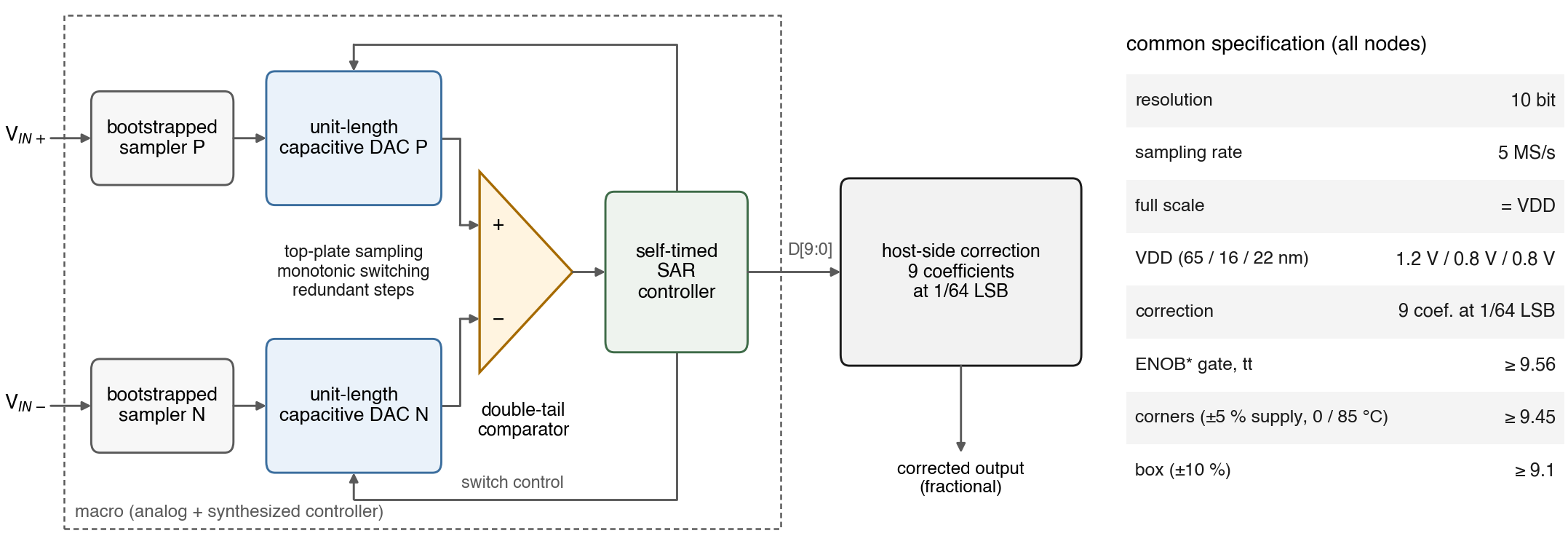
10-bit, 5-MS/s asynchronous SAR ADC · one specification across 65-nm bulk CMOS, 22-nm FD-SOI and 16-nm FinFET.
Overview
The delivered macros in one comparison.
Physical verification
DRC, LVS and antenna checks; technology-specific scope is recorded in the sign-off details.
Electrical verification
PVT, Monte Carlo, linearity, conversion timing and start-up.
Extracted-layout results
Post-layout simulation across 65-nm bulk CMOS, 16-nm FinFET and 22-nm FD-SOI.
Measure
65-nm bulk
16-nm FinFET
22-nm FD-SOI
Supply
1.2 V
0.8 V
0.8 V
Typical ENOB*
9.71 bit
9.63 bit
9.62 bit
Typical SNDR*
60.2 dB
59.8 dB
59.6 dB
Macro area (rounded)
2,400 µm²
1,700 µm²
2,200 µm²
Power at 5 MS/s
46.4 µW
42.4 µW
25.1 µW
Energy / conversion
9.29 pJ
8.48 pJ¹
5.02 pJ
Walden FoM
11.1 fJ/step
10.7 fJ/step
6.4 fJ/step
Lowest ENOB* (±5% supply, 0–85 °C)
9.491
9.555
9.464
Missing-code estimate
0 / 20,000 dies
0 / 20,000 dies
0.01%
Human hands-on
4 h 30 (from scratch)
1 h (port)
1 h (port)
*The project’s code-set-corrected metric for short 128-point post-layout records. ¹The 16-nm energy is estimated from a capacitance-only twin record. Monte Carlo missing-code values are estimates, not silicon measurements.
Verification
Block-level evidence and remaining integration gates.
Check
65 nm
16 nm
22 nm
DRC / LVS / antenna
Recorded
Recorded¹
Recorded¹
Nominal ENOB*
9.710 ± 0.028
9.634 ± 0.045
9.616 ± 0.046
Worst full-accuracy corner
9.491
9.555
9.464
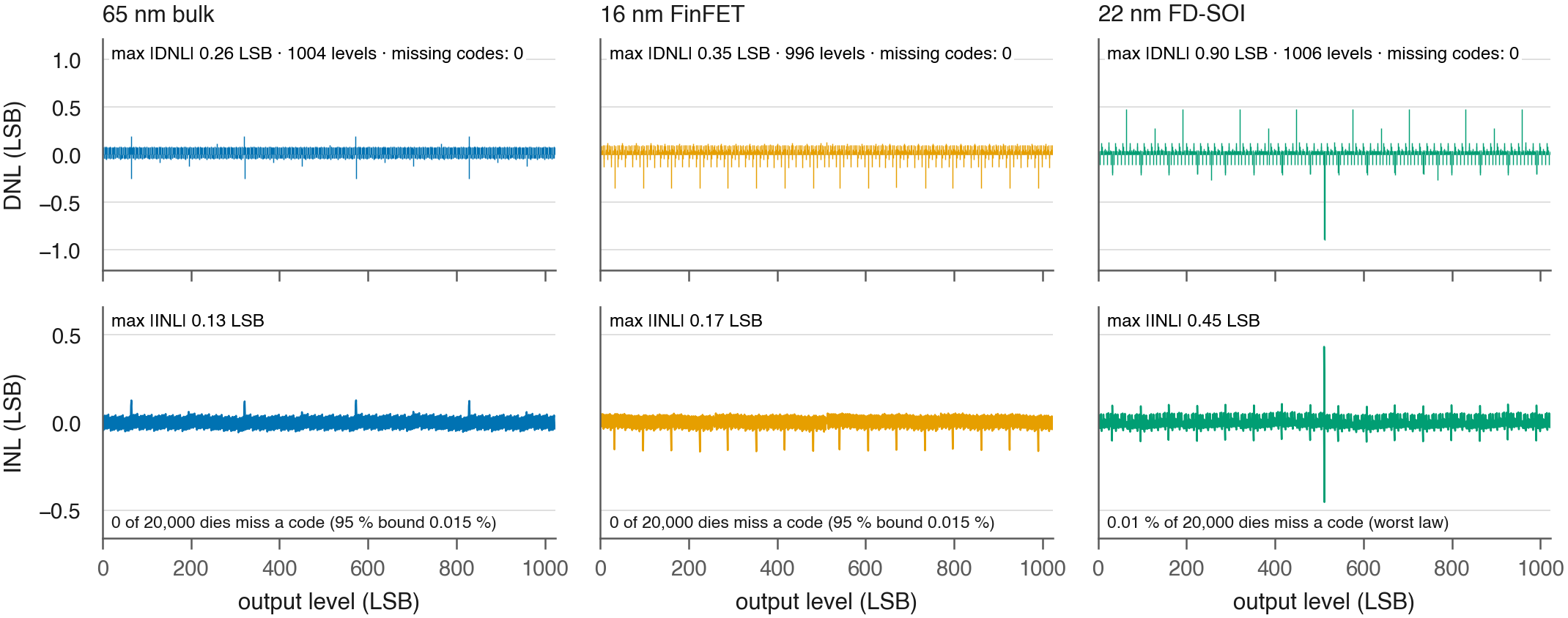
Nominal max |DNL| / |INL|
0.26 / 0.13 LSB
0.35 / 0.17 LSB
0.90 / 0.45 LSB
Slowest conversion (100 ns window)
80.8 ns
87.5 ns
78.9 ns
Start-up words discarded
10
1
2
¹Multi-patterning deck checks were not run at 16 or 22 nm. The 16-nm electromigration check was not closed because the installed kit lacked limits. The delivered macro packages record these open integration gates; the page does not claim silicon validation.
Architecture & layouts
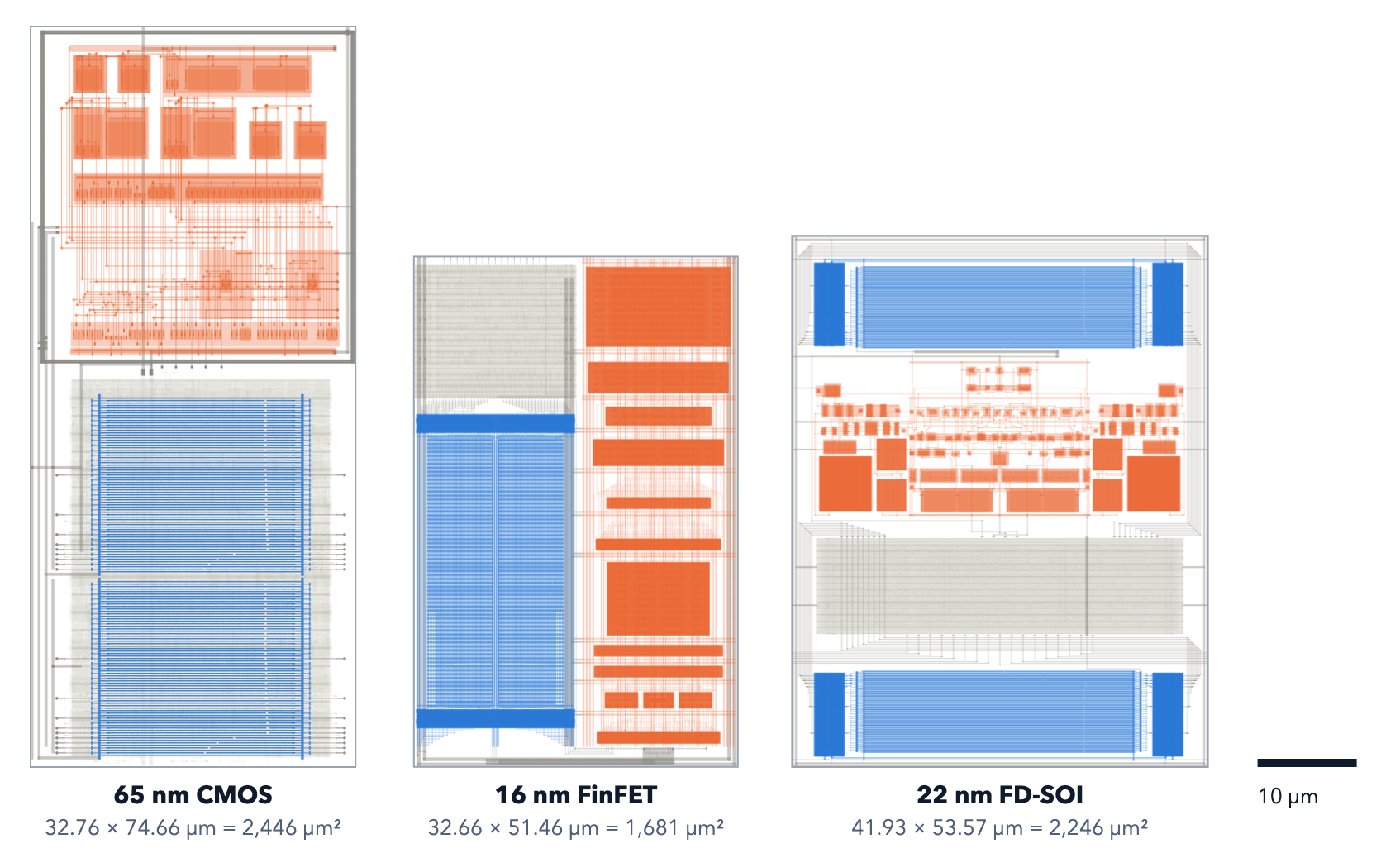
One 10-bit, 5-MS/s specification; three physical implementations.
The same converter architecture and specification underlie each technology.The DAC, comparator, samplers and controller are coloured by function; all layouts use one scale.
Survey comparison
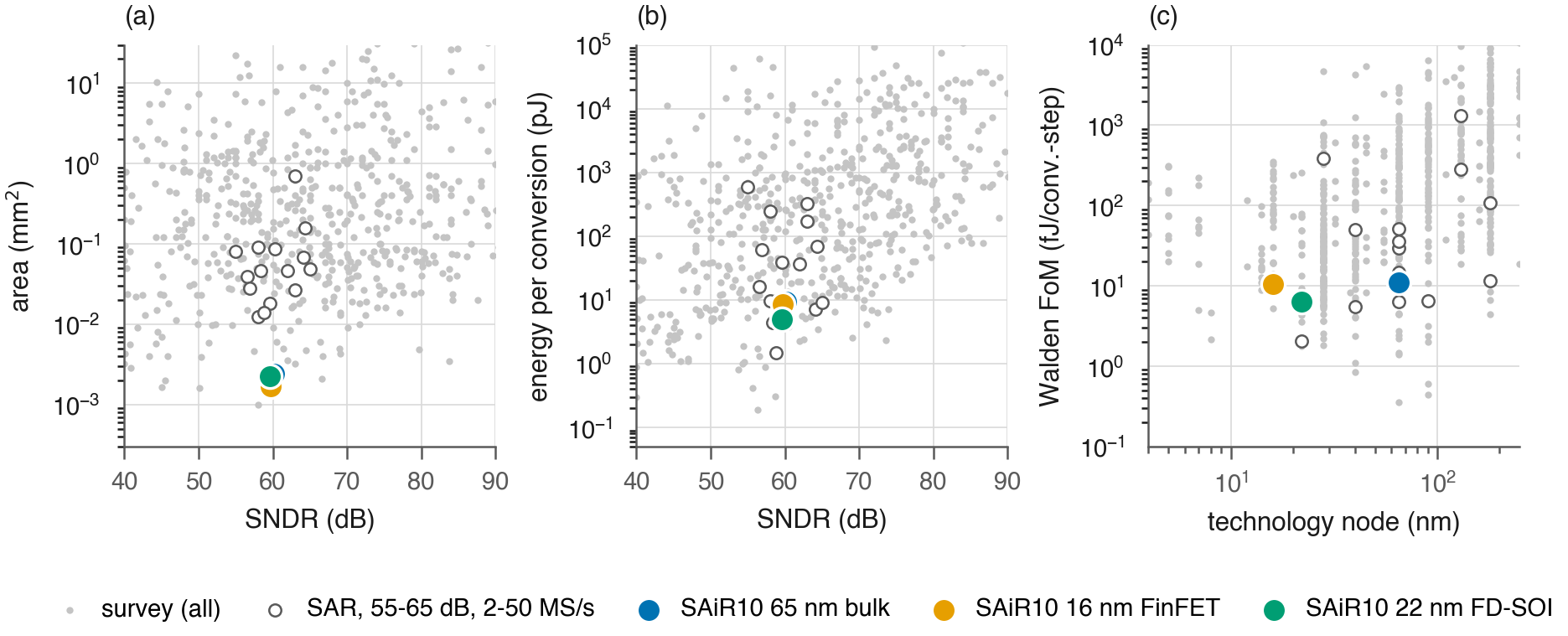
Post-layout simulated results alongside measured published ADCs.
Coloured SAiR10 points are post-layout simulation; grey survey points are measured silicon.
The comparison shows context, not a silicon-to-silicon claim. The same-class subset is identified separately in the source analysis.
Corners & linearity
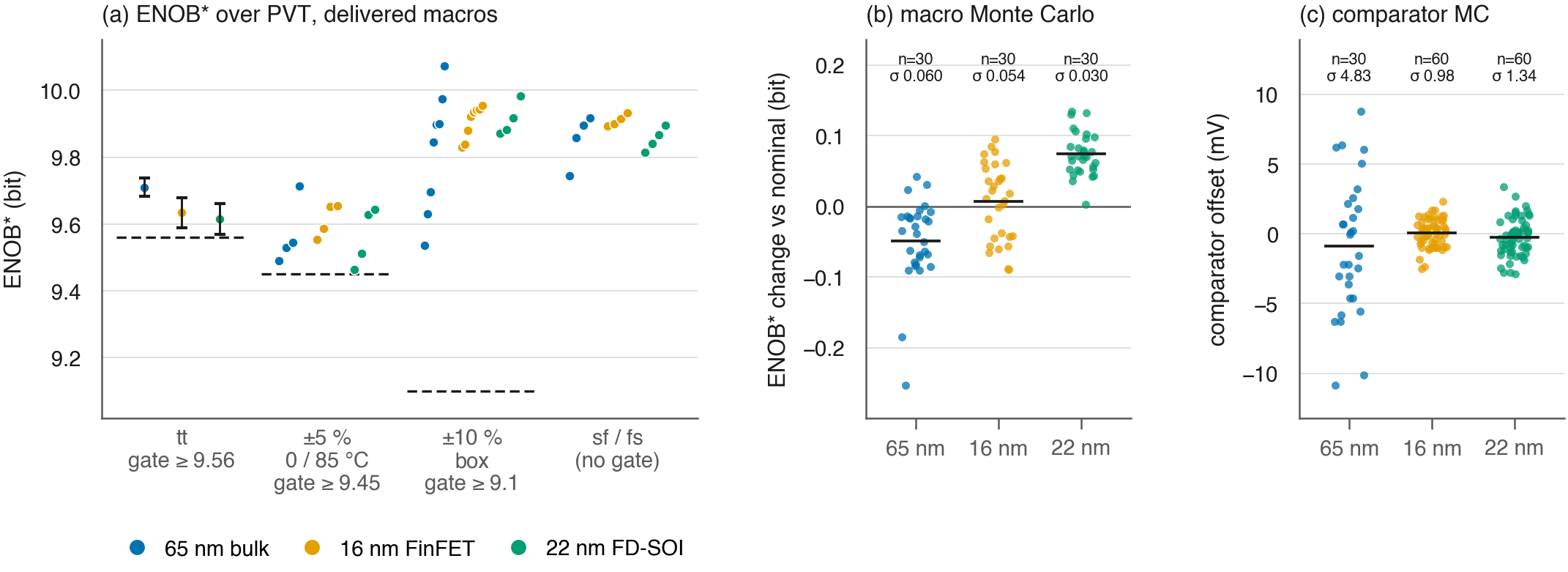
Accuracy was checked beyond the nominal record.
ENOB* over process, voltage and temperature; macro and comparator Monte Carlo shown alongside.Calibrated static-model DNL and INL use extracted DAC weights and measured comparator thresholds.
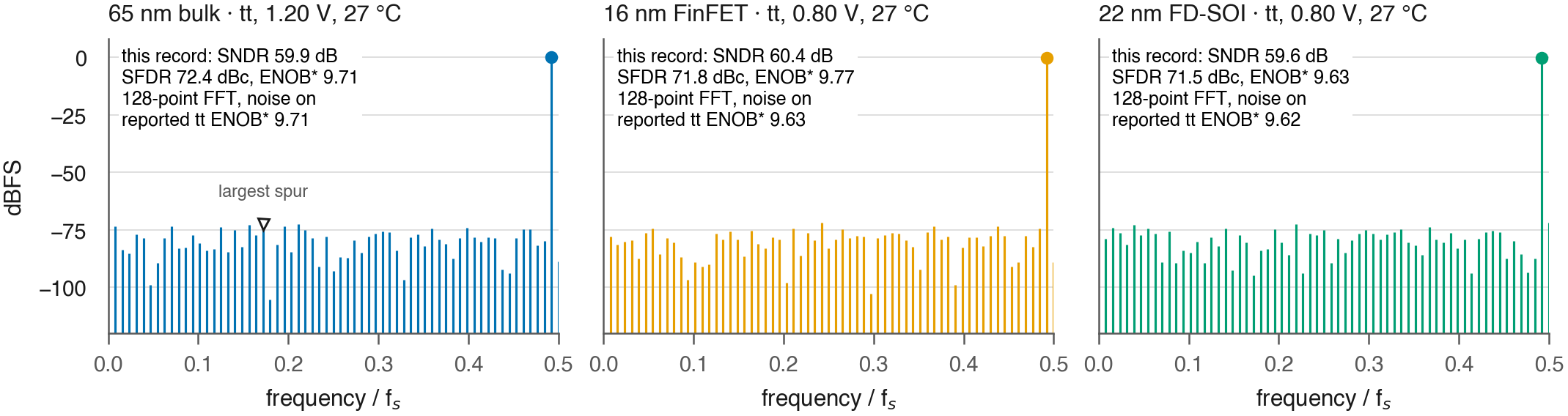
Output spectra
Typical-corner records with device noise on.
One 128-point post-layout FFT record per technology. The reported typical ENOB* is an average of several records.
Energy breakdown
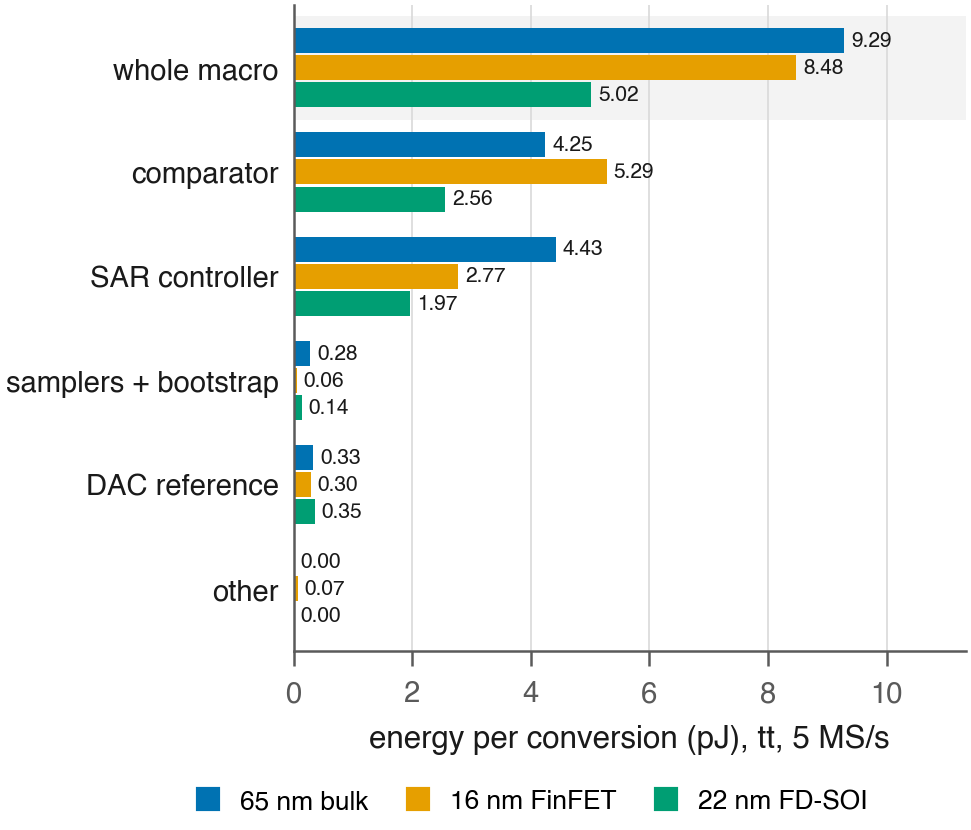
Where the conversion energy goes.
Updated delivered-macro figure: whole macro, comparator, controller, samplers, DAC reference and other circuits.
Updated 16-nm value: 8.48 pJ per conversion, not the earlier deck’s 8.61 pJ. Its block split is an estimate scaled from a capacitance-only twin record.
Reported values are post-layout simulation with extracted parasitics, not silicon measurements. Area is rounded; 16-nm energy is a capacitance-only estimate. · Raphael Viera (raphaelviera.com)